

From electric vehicles to medical devices and consumer electronics, lithium-ion batteries are central to modern life.

As industries push toward lighter, more energy-efficient, and cost-effective technologies, lithium-ion battery (LIB) manufacturers are increasingly turning to advanced engineering plastics like PFA (Perfluoroalkoxy alkane) and PPSU (Polyphenylsulfone). These materials offer a combination of thermal stability, chemical resistance, electrical insulation, and design flexibility—characteristics that are critical for safe, high-performance battery systems.
From electric vehicles (EVs) to medical devices and consumer electronics, lithium-ion batteries are central to modern life. As a result, every improvement in battery performance, safety, and cost efficiency can have far-reaching implications. Among the most significant advances in recent years has been the increased use of injection molded thermoplastics in battery design and manufacturing.
Why Plastics Are Displacing Metals in Batteries
Traditionally, many components in lithium-ion batteries were made of metals. While metals offer strength and conductivity, they come with several limitations:
- Weight: Metal adds bulk, reducing overall energy efficiency.
- Corrosion: Exposure to electrolytes and high temperatures can degrade metal components over time.
- Manufacturing Limitations: Metals are less adaptable to rapid prototyping, miniaturization, or complex geometries.
Plastics, especially high-performance types like PFA and PPSU, overcome these challenges. They are significantly lighter, resist a broad range of chemicals, and can be injection molded into complex shapes with tight tolerances. This enables the production of thinner, more compact battery packs without sacrificing strength or functionality.
Key Plastic Components in Lithium-Ion Batteries
1. Battery Separators
Battery separators are critical in preventing contact between the anode and cathode, while still allowing ion transfer. While polyolefins like polyethylene (PE) and polypropylene (PP) are traditionally used, high-performance batteries increasingly incorporate fluoropolymers like PFA for improved chemical resistance and thermal stability.
2. Casings and Enclosures
Injection molded PPSU and PFA are being used to fabricate external and internal battery housings. PPSU, known for its toughness and flame resistance, is ideal for structural applications that may face mechanical stress. PFA offers exceptional chemical resistance, making it suitable for components exposed to reactive electrolytes or off-gassing environments.
3. Gaskets and Seals
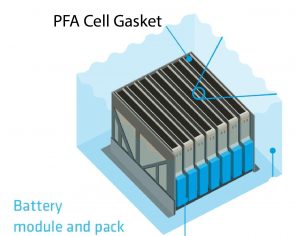
Battery packs rely heavily on gaskets and seals to maintain integrity under temperature changes and vibrations. Plastics such as Ultem® (PEI), Ryton® (PPS), and PFA are ideal for these applications due to their low outgassing, high thermal endurance, and ability to mold thin walls (as little as 0.012″). These gaskets are now commonly used in cylindrical and prismatic cells, replacing traditional elastomeric or metal-based seals.
4. Thermal Barriers and Fire Protection Layers
In case of thermal runaway—a condition where the battery overheats and may catch fire—components made from flame-resistant plastics like PPSU and PEEK can act as thermal barriers to protect adjacent cells or enclosures. Their use reduces the propagation of heat and fire within the battery pack.
5. Sensor and Connector Housings
Lithium-ion batteries often include sensors for voltage, temperature, and current monitoring. These sensors need housing materials that provide dimensional stability and resist degradation over time. Injection molded PPSU and PFA offer the necessary dielectric properties and long-term durability.
6. Manifold and Venting Systems
Some battery modules incorporate venting or fluid management systems to control pressure buildup or direct cooling fluids. Injection molded components, especially from fluoropolymers, offer chemically inert and dimensionally stable solutions, even under continuous exposure to battery fluids or coolants.
7. Electrolyte Delivery Systems
In batteries using gel or polymer electrolytes, components responsible for dispensing or containing these substances benefit from the non-reactive nature of PFA. This ensures that electrolyte integrity is preserved, and no contaminant leaching occurs from the container material.
Advanced Manufacturing for High-Performance Battery Plastics
Performance Plastics specializes in the precise engineering and production of such complex plastic components. Using advanced molding technologies, including direct gating of fluoropolymers, we provide cost-effective, scalable, and repeatable manufacturing solutions that meet the demanding requirements of lithium-ion battery OEMs.
Key capabilities include:
- Clean Room Manufacturing: Essential for components sensitive to contamination, such as electrolyte-contact parts or high-voltage insulation systems.
- Thin-Wall Injection Molding: Allows production of lightweight parts with wall thicknesses as small as 0.012″, contributing to overall pack miniaturization.
- High-Volume Production: Suitable for automotive and consumer electronics applications where millions of parts are needed annually.
- Automated Inspection: Ensures consistent quality, dimensional accuracy, and compliance with stringent industry
Future Trends in Battery Design with Plastics
The growing emphasis on sustainability and recyclability in battery design may further encourage the use of polymers. For instance:
- Design for Disassembly: Modular battery systems that use plastic clips and housings instead of welded metal parts simplify end-of-life disassembly and recycling.
- Lower Carbon Footprint: High-performance plastics often have lower manufacturing energy requirements compared to metals.
- Integration with Smart Systems: Plastics can be easily overmolded with electronics or sensors, enabling smarter battery management systems (BMS) directly embedded in the housing.
Industries Benefiting from Plastic-Enhanced Batteries
The applications for injection molded PFA and PPSU in lithium-ion batteries span across many sectors:
- Automotive: Electric vehicles (EVs), hybrid vehicles, and e-bikes
- Medical Devices: Portable defibrillators, infusion pumps, and surgical robots
- Consumer Electronics: Smartphones, laptops, and wearable tech
- Industrial Equipment: Power tools, backup systems, and robotic automation
- Energy Storage Systems (ESS): Grid-level battery banks and home energy solutions
In each of these fields, weight reduction, chemical resistance, fire safety, and ease of assembly are essential—and performance plastics deliver.
As lithium-ion battery technologies evolve, the role of injection molded high-performance plastics like PFA and PPSU will only continue to expand. These materials provide unmatched flexibility, performance, and reliability, opening the door to safer, lighter, and more cost-effective energy storage solutions.
At Pexco, we specialize in solving the toughest design and manufacturing challenges. Whether you’re developing the next generation of EV batteries or seeking to improve thermal management in portable power systems, we have the materials expertise and processing capabilities to help you succeed. For more information on how we can assist with your next project, please visit our website at pexco.com/contact-us/