Advanced Polymer Solutions for Data Centers: Materials, Fluid Handling, and Thermal Management for the AI Era

Quick Answer
Data centers built for AI and high-performance computing rely on fluoropolymers — primarily PFA, PTFE, FEP, and PVDF — for fluid-handling and cooling-loop components, paired with silicone, EPDM, or TPV/TPE seals for leak prevention. These materials are chosen for chemical resistance to coolants, continuous-use temperatures up to 500°F (260°C), and long-term dimensional stability under constant thermal cycling. PC/ABS and reinforced thermoplastics handle high-density cable management and routing. Pexco manufactures Altaflo® fluoropolymer tubing, Insultab® heat shrink products, custom extruded profiles, and precision-molded seals and gaskets for each of these application areas. Rigid thermoplastic piping systems such as PVC, CPVC, PVDF, and PFA also support facility-level coolant, water, and specialty fluid distribution where corrosion resistance, chemical compatibility, and long-term reliability are required.
The Future of Data Centers Depends on Materials Innovation
Artificial intelligence, machine learning, cloud computing, and edge processing are transforming the global data center industry. As computational demands continue to increase, operators are building larger, denser, and more power-intensive facilities than ever before. Traditional air-cooling architectures are reaching their practical limits, forcing a rapid shift toward liquid cooling systems, advanced thermal management strategies, and higher-performance infrastructure materials.
While processors, servers, and networking equipment often receive the most attention, the materials that support these systems play a critical role in data center reliability, efficiency, and uptime. Fluid handling systems, cooling loops, cable management infrastructure, seals, gaskets, and electrical protection components must operate continuously in demanding environments where downtime is unacceptable.
In addition to flexible tubing, modern data centers rely on rigid thermoplastic piping systems to distribute cooling water, treated process fluids, and specialty coolants throughout the facility. Materials such as PVC, CPVC, PVDF, and PFA can provide corrosion resistance, long service life, lower weight than metal alternatives, and compatibility with demanding cooling and fluid-handling environments.
Modern data centers require materials that can:
- Withstand continuous thermal cycling
- Resist chemical degradation from advanced coolants
- Support high-density cable routing
- Maintain dimensional stability
- Meet stringent flame and safety standards
- Enable scalable, modular facility designs
- Deliver long-term reliability with minimal maintenance
As a North American leader in engineered polymer solutions, Pexco provides Altaflo® fluoropolymer tubing, Insultab® heat shrink products, custom extrusions, machined components, molded parts, seals, and thermal management solutions that help data center operators, OEMs, and infrastructure designers meet these challenges.
Pexco products map directly to the four core infrastructure categories where material performance is most critical:
- Altaflo® PFA and Fluoropolymer Tubing for direct-to-chip cooling loops and high-purity coolant delivery
- Rigid PVC, CPVC, PVDF, and PFA piping systems for facility-level cooling water, utility, high-purity, and specialty coolant distribution
- Custom Extruded Profiles for cable raceways, routing channels, and airflow management
- Insultab® Heat Shrink Tubing for wire identification, insulation, and abrasion protection in high-density environments
- Custom Extruded and Molded Seals and gaskets for leak-critical liquid cooling assemblies
Why Are Data Centers Changing So Quickly?
The rise of AI has fundamentally altered the design requirements for data center infrastructure.
Traditional enterprise data centers were designed around server racks drawing roughly 6 to 15 kW. Today’s AI training clusters and high-performance computing (HPC) systems are pushing density to 30–40 kW per rack as a baseline, and the latest GPU platforms — including NVIDIA’s GB200 NVL72 racks — are reaching 120 kW or more in a single rack. That is several times the thermal load of a traditional enterprise rack, concentrated in the same physical footprint.
These increased power densities create three significant challenges:
1. Thermal Management
Heat has become one of the largest constraints on data center performance.
Modern AI racks often exceed the cooling capabilities of conventional air-cooled systems, driving adoption of:
- Direct-to-chip liquid cooling
- Rear-door heat exchangers
- Immersion cooling systems
- Hybrid cooling architectures
- Advanced coolant distribution networks
Industry market research projects the global data center liquid cooling market to grow from roughly $6.6 billion in 2025 to nearly $29.5 billion by 2033 — a clear signal of how quickly operators are moving away from air-cooled architectures.
2. Infrastructure Density
Organizations are deploying more computing power into smaller footprints.
This trend requires:
- Higher-density fiber routing
- Improved cable management
- More efficient airflow pathways
- Modular containment systems
- Compact fluid distribution assemblies
3. Reliability Requirements
Data centers operate around the clock.
Any failure involving cooling systems, fluid leaks, electrical connections, or infrastructure components can result in:
- Costly downtime
- Equipment damage
- Lost productivity
- Reduced service availability
At rack densities above 100 kW, even a brief cooling-loop failure can force an emergency shutdown within minutes — a far narrower margin for error than legacy air-cooled environments allowed.
As a result, material selection has become a strategic engineering decision rather than a commodity purchasing exercise.
What Makes Engineered Polymers Better Than Metal for Data Center Components?
Engineered polymers offer a unique combination of performance characteristics that make them ideal for data center applications.
Compared with traditional metal components, advanced polymer materials often provide:
- Superior corrosion resistance
- Reduced weight
- Enhanced electrical insulation
- Chemical compatibility
- Design flexibility
- Lower maintenance requirements
When properly selected, polymer components can improve both operational efficiency and equipment longevity.
Why Is Liquid Cooling the Fastest-Growing Data Center Technology?
Liquid cooling is rapidly becoming the preferred solution for high-density computing environments.
Unlike air, liquids transfer heat far more efficiently, enabling operators to cool increasingly powerful processors without expanding facility footprints. Recent industry surveys suggest fewer than half of data centers still rely on air cooling alone, with the remainder running liquid or hybrid systems — and that share is expected to keep shifting toward liquid cooling as AI rack densities climb.
The success of these systems depends heavily on fluid handling components.
Critical components include:
- Tubing
- Pipe systems
- Cooling manifolds
- Heat exchangers
- Seals and gaskets
- Quick-connect assemblies
These components must withstand continuous exposure to cooling fluids while maintaining dimensional stability and leak-free performance.
Flexible tubing is often used inside equipment and rack-level cooling assemblies, while rigid thermoplastic piping forms the backbone of many facility-wide cooling networks. PVC and CPVC are commonly used for chilled water, condenser water, and utility piping, while PVDF and PFA are specified where higher purity, enhanced chemical resistance, or specialty coolant compatibility is required.
What Are the Best Materials for Data Center Fluid Handling Systems?
PFA (Perfluoroalkoxy)
PFA is widely considered one of the premier materials for high-performance fluid handling systems, with a continuous-use temperature rating up to 500°F (260°C).
Benefits include:
- Exceptional chemical resistance
- High temperature capability — up to 500°F (260°C) continuous
- Excellent purity characteristics
- Low extractables
- Smooth internal surfaces
- Long service life
PFA is commonly used in:
- Direct-to-chip cooling loops
- High-purity coolant delivery systems
- Manifold assemblies
- Precision fluid distribution networks
- High-purity piping systems
- Specialty coolant transport
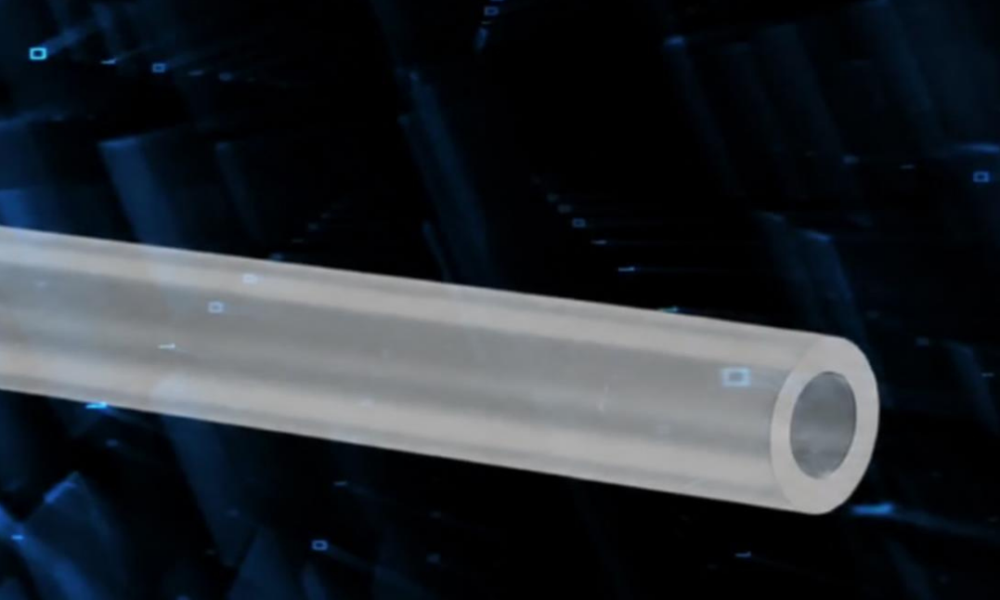
Pexco manufactures Altaflo® PFA tubing for high-purity cooling loops in data center and semiconductor environments. Altaflo® is available in standard and custom dimensions and is designed to meet the low-extractable, high-purity requirements of direct-to-chip and immersion cooling applications. PFA may also be specified for high-purity piping and specialty coolant transport where cleanliness, chemical compatibility, and thermal performance are critical.
PTFE (Polytetrafluoroethylene)
PTFE offers industry-leading chemical resistance and the broadest temperature range of any fluoropolymer — from roughly –450°F to 500°F (–268°C to 260°C).
Advantages include:
- Near-universal chemical compatibility
- Non-stick surfaces
- Outstanding thermal performance across extreme temperature swings
- Low friction characteristics
Common applications include:
- Fluid transfer systems
- Thermal management assemblies
- Specialty heat exchangers
- Critical sealing components
Pexco produces PTFE-based components including seals, gaskets, and specialty thermal assemblies. PTFE’s non-melt-processable nature makes it well suited for static sealing applications and custom-machined components within fluid handling systems.
FEP (Fluorinated Ethylene Propylene)
FEP combines many fluoropolymer performance advantages with enhanced flexibility and transparency, though its continuous-use rating (roughly 400°F / 205°C) is lower than PFA or PTFE.
Typical applications include:
- Coolant transfer lines
- Monitoring systems where visual inspection matters
- Flexible fluid routing
- Specialty fluid handling assemblies
Pexco FEP tubing supports flexible routing and visual flow monitoring in cooling systems where transparency and bend radius matter. It is commonly specified for secondary coolant lines and monitoring loops alongside PFA primary distribution tubing.
PVDF (Polyvinylidene Fluoride)
PVDF provides a balance of strength, chemical resistance, and processability, with a continuous-use rating around 280°F (138°C).
Benefits include:
- Excellent mechanical properties
- Chemical resistance
- Abrasion resistance
- Long-term durability
Common uses include:
- Fluid distribution systems
- Fluid distribution piping
- Pump components
- Chemical handling assemblies
- Cooling infrastructure
- High-purity process piping
Pexco produces PVDF tubing and fluid handling components for applications requiring a combination of chemical resistance, mechanical strength, and long-term reliability. PVDF is commonly specified for piping systems, fittings, pump components, and structural fluid handling assemblies where performance demands exceed those of standard thermoplastics.
PVC (Polyvinyl Chloride)
PVC is one of the most widely used thermoplastic piping materials in industrial and utility fluid-handling systems. Its corrosion resistance, ease of installation, and cost effectiveness make it well suited for many non-critical water distribution applications within data center infrastructure.
Common uses include:
- Utility water systems
- Secondary cooling water distribution
- Drainage systems
- Process water transport
For facilities seeking lightweight alternatives to metal piping, PVC offers long service life and strong resistance to corrosion and scaling.
CPVC (Chlorinated Polyvinyl Chloride)
CPVC extends the capabilities of traditional PVC by providing improved temperature resistance and enhanced mechanical performance. These properties make CPVC a practical choice for higher-temperature fluid-handling applications found in data center cooling systems.
Common uses include:
- Chilled water distribution
- Cooling infrastructure piping
- Mechanical room fluid handling
- Process fluid transport
CPVC combines corrosion resistance with higher temperature capability, making it a practical alternative to metal piping systems in many thermal management applications.
What Other Thermal Management Components Do Data Centers Need Beyond Cooling Loops?
Thermal management extends far beyond moving coolant through a system.
Data centers require integrated approaches that include:
- Heat exchangers
- Thermal isolation components
- Fluid containment systems
- Cable protection systems
- Environmental controls
Advanced polymer materials help engineers manage heat while reducing contamination risks and maintenance requirements.
What Materials Are Used for Data Center Cable Management?
Data center cable management systems use engineered thermoplastics — primarily PC/ABS blends and reinforced polymer profiles — for raceways, routing channels, and support structures, combined with heat shrink tubing at the wire and connector level for insulation, identification, and environmental sealing. Pexco extrudes custom cable raceway profiles up to 30 inches wide and manufactures Insultab® heat shrink tubing to UL 224 VW-1 specifications.
Effective cable management solutions help:
- Improve airflow
- Reduce installation complexity
- Simplify maintenance
- Protect sensitive infrastructure
- Support future expansion
Wide-format extruded raceways address the routing demands of high-density fiber and copper environments that off-the-shelf components cannot. Pexco’s extrusion capability extends to 30-inch-wide profiles — a dimensional range that accommodates high-count fiber trunk runs, multi-tier copper routing, and integrated airflow channels in a single extruded cross-section. Custom raceway profiles can be designed to fit specific rack footprints, cabinet configurations, and hot aisle/cold aisle airflow management requirements, eliminating the stacking of multiple narrower channels and the associated installation complexity.
Insultab® heat shrink tubing from Pexco provides protection at the individual wire and connector level. In high-density data center environments, Insultab® serves four distinct functions: electrical insulation at terminations, color-coded circuit identification across high cable-count installations, abrasion protection at cable entry points and bend radii, and environmental sealing around connectors exposed to humidity or cleaning agents. Insultab® is available in polyolefin, PVC, and specialty fluoropolymer constructions, with ratings available to UL 224 VW-1 and other applicable standards.
What Seal and Gasket Materials Prevent Leaks in Liquid-Cooled Data Centers?
Reliability is paramount in liquid-cooled environments. Even minor leaks can threaten uptime and damage expensive equipment.
Precision-engineered seals, gaskets, and containment systems help maintain system integrity under:
- Temperature fluctuations
- Pressure changes
- Humidity variations
- Continuous operation
Silicone
Ideal for flexibility and temperature resistance.
EPDM
Provides excellent environmental resistance and long-term durability.
TPV and TPE
Deliver flexibility, sealing performance, and manufacturing versatility.
Fluoropolymer-Based Components
Offer unmatched chemical compatibility for aggressive fluid environments.
Pexco develops precision-engineered sealing systems for liquid-cooled data center infrastructure, including custom extruded gasket profiles, injection-molded seals, and multi-material sealing assemblies. Custom sealing components can be designed to meet specific coolant compatibility, compression set, and dimensional requirements — critical in leak-sensitive cooling loops where standard catalog parts may not provide a reliable long-term fit.
Material Selection Guide for Data Centers
The table below maps common data center applications to the materials best suited for each, based on the properties discussed above.
| Application | Recommended Materials | Key Property | Key Property |
| High-Purity Fluid Systems | PFA, HP PFA, PVDF, PTFE | Low extractables, high purity | Altaflo® PFA tubing |
| Aggressive Coolants | PTFE, PFA, PVDF | Broad chemical resistance | Altaflo® PFA / PTFE tubing; FEP monitoring lines |
| Cable Management | PC/ABS, reinforced thermoplastics | Impact resistance, flame rating | Custom extruded profiles and raceways |
| High-Temperature Components | PEEK, PEI, PTFE | Continuous service to 500°F+ (260°C+) | Machined PTFE components; custom fluoropolymer assemblies |
| Seals and Gaskets | Silicone, EPDM, TPV/TPE | Flexibility, environmental resistance | Custom extruded and molded seals and gaskets |
| Wire Protection & Identification | Polyolefin, PVC, specialty heat shrink | Insulation, color-coding, abrasion resistance | Insultab® heat shrink tubing |
| Cooling Water & Utility Piping | PVC, CPVC, PVDF, PFA | Corrosion resistance, chemical compatibility, lightweight installation | Custom piping and fluid-handling solutions |
What Compliance Standards Apply to Data Center Infrastructure Components?
Data center infrastructure often requires compliance with industry standards and certifications including:
- UL 94 V-0
- UL 224 VW-1
- SEMI F57
- SEMI C90
- ASTM material standards
These standards help ensure component performance, reliability, and safety across mission-critical environments.
Why Do OEMs and Operators Partner with Pexco?
Data center infrastructure projects require more than individual products. They require engineering expertise, materials knowledge, and manufacturing capabilities capable of supporting long-term growth.
Pexco combines:
- Fluoropolymer expertise
- Heat shrink manufacturing
- Precision extrusion
- Injection molding
- CNC machining
- Tooling design
- Prototyping support
- Engineering consultation
- U.S.-based manufacturing
This integrated approach allows OEMs, hyperscale operators, system integrators, and equipment manufacturers to source multiple critical components from a single partner.
The Future of Data Center Infrastructure
The next generation of data centers will be defined by higher rack densities, greater thermal loads, more sophisticated cooling architectures, and increasing demands for reliability.
As liquid cooling adoption accelerates and AI infrastructure expands, material performance will play an increasingly important role in facility design.
Advanced fluoropolymers, engineered thermoplastics, elastomers, and custom polymer solutions will continue enabling the infrastructure that powers artificial intelligence, cloud computing, and the digital economy.
Organizations that invest in the right materials today will be better positioned to improve efficiency, reduce maintenance, and scale for tomorrow’s computing demands.
Frequently Asked Questions
What is the best material for data center liquid cooling tubing?
PFA and PTFE are generally the top choices for liquid cooling tubing because of their broad chemical compatibility, low extractables, and continuous-use temperatures up to 500°F (260°C). FEP is a common alternative where flexibility and transparency matter more than peak temperature rating.
Is PFA or PTFE better for direct-to-chip cooling loops?
Both perform well. PFA is melt-processable, which makes it easier to form into precision tubing, fittings, and manifold components with smooth, low-particulate internal surfaces — an advantage in high-purity coolant loops. PTFE is not melt-processable but offers a slightly broader temperature range and is often used for static seals and gaskets within the same system.
What temperature can PFA tubing withstand in data center cooling systems?
PFA is typically rated for continuous use up to 500°F (260°C), well above the operating range of any coolant used in standard direct-to-chip or immersion cooling applications.
What seal materials are used in liquid-cooled data center racks?
Silicone and EPDM are the most common choices for general environmental sealing, while TPV and TPE are used where manufacturing flexibility matters. Fluoropolymer-based seals are specified for components in direct contact with aggressive or specialty coolants.
What compliance standards apply to data center fluid handling components?
Common standards include UL 94 V-0, UL 224 VW-1, SEMI F57, SEMI C90, and relevant ASTM material standards, depending on the application and coolant type.
What is the difference between PFA and FEP for data center applications?
PFA offers a higher continuous-use temperature (up to 500°F/260°C versus roughly 400°F/205°C for FEP) and better mechanical properties at elevated temperatures. FEP is more flexible and more transparent, which makes it useful for monitoring lines and flexible routing where visual inspection or bend radius matters more than peak temperature.
Why is air cooling no longer sufficient for AI data centers?
Traditional air cooling was designed for racks drawing roughly 6 to 15 kW. AI training racks now routinely exceed 30 to 40 kW, and some of the latest GPU platforms reach 120 kW or more in a single rack — densities that air alone cannot remove efficiently, which is why liquid cooling has become standard for AI infrastructure.
What materials are used for data center cable management?
PC/ABS and reinforced engineered thermoplastics are widely used for cable raceways, routing systems, and support structures because they combine impact resistance, dimensional stability, and compliance with flame-rating standards like UL 94 V-0.
What piping materials are used in modern data centers?
Modern data centers commonly use PVC, CPVC, PVDF, and PFA piping systems in addition to flexible fluoropolymer tubing. PVC and CPVC are often specified for chilled water and utility fluid distribution, while PVDF and PFA are selected for high-purity, chemically aggressive, or specialty coolant applications requiring enhanced performance and durability.
Partner with Pexco for Data Center Infrastructure Solutions
From Altaflo® fluoropolymer tubing and fluid handling systems to custom cable management profiles, heat shrink products, seals, gaskets, and engineered polymer components, Pexco helps data center designers build reliable, scalable infrastructure for the future.
Contact our engineering team to discuss your specific application. Our team can help with material selection guidance, cooling loop design requirements, custom component development, and qualification support for new builds and facility expansions.
Related Resources
Authors
Written by:
Kim Imes, Senior Demand Generation Manager, creates customer-focused content that simplifies complex technical topics and helps customers make confident, informed decisions.
Reviewed by:
Dana Scott, Director of Sales and Market Development, provides extensive sales leadership and customer insight, ensuring solutions meet real-world business needs and deliver measurable results.