
Plastics and Elastomers for Medical Devices and Pharmaceutical Applications
Medical tubing, surgical instrument insulation, and pharmaceutical fluid paths serve different purposes, but each depends on materials that perform consistently under defined conditions. Plastics and elastomers give engineers options for balancing flexibility, chemical resistance, dimensional precision, and manufacturing requirements across these applications.
Selecting the right polymer starts with how the component will be used. Patient contact, exposure to a drug formulation, repeated cleaning, and sterilization can each change the material requirements. Evaluating these conditions early helps connect component design with the performance and documentation needed for the finished device or process.
Where polymers support medical and pharmaceutical performance
In medical devices, tubing may carry fluids, protect internal elements, or form part of a catheter assembly. Molded and machined components can provide the precise features needed for equipment interfaces and fluid-handling assemblies. Heat shrink can insulate instruments or secure and protect device components.
Pharmaceutical applications add a different set of fluid-contact considerations. Tubing and components used in processing, transfer, sampling, or filling must be evaluated against the formulation and cleaning conditions. Chemical resistance alone does not establish suitability: the potential for extractables, leachables, adsorption, and contamination also needs to be assessed for the intended use.
Which plastics and elastomers are used in medical tubing
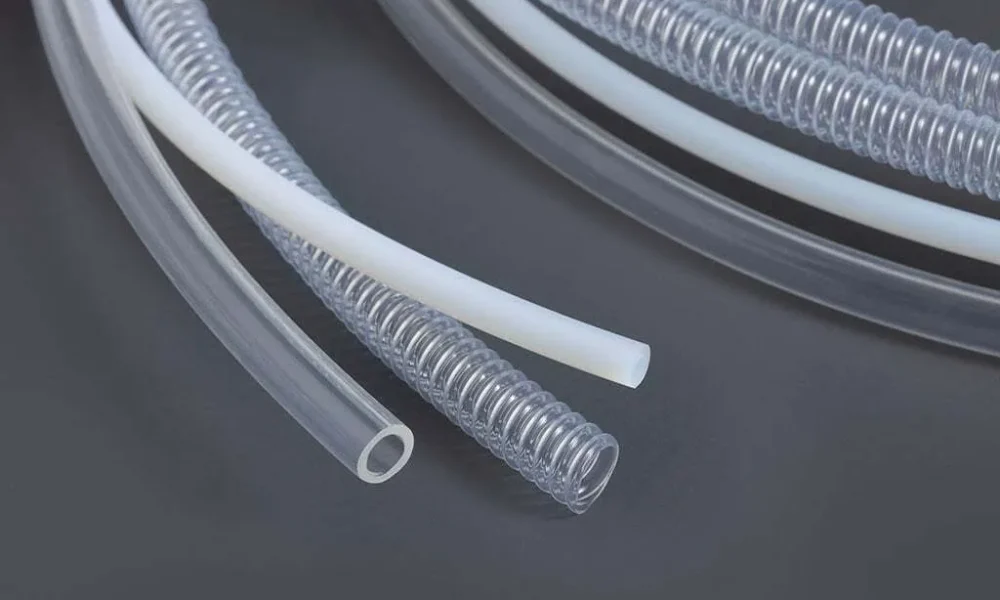
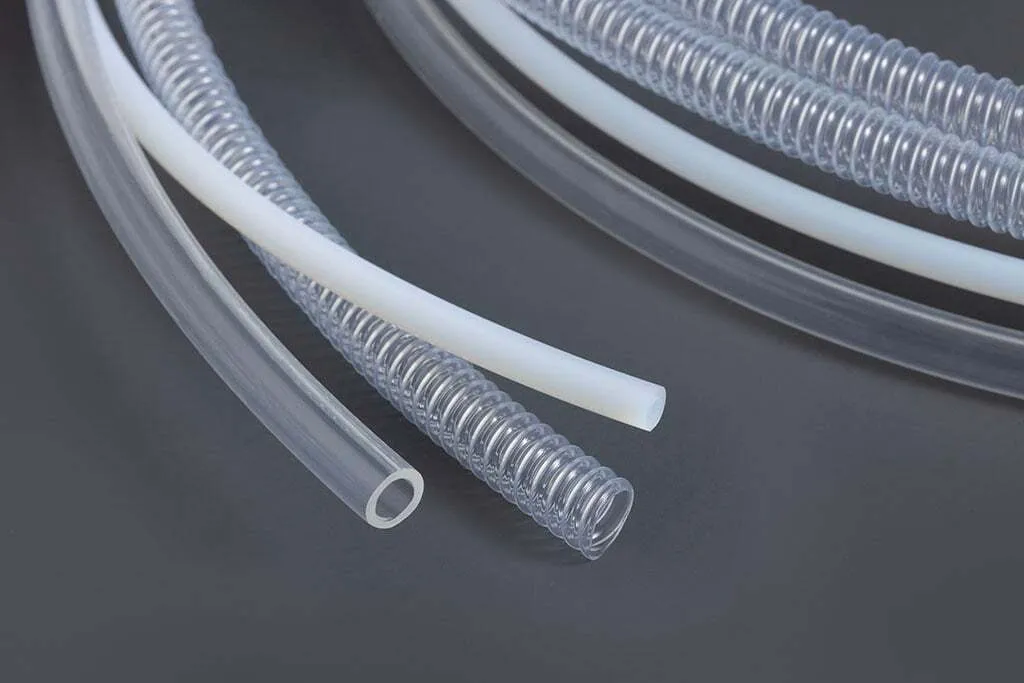
Medical tubing materials include PVC, polyurethane, thermoplastic elastomers, silicone, and fluoropolymers. Each offers a different balance of properties, and performance depends on the specific grade, formulation, dimensions, and processing history.
Flexible PVC is commonly used in IV and respiratory tubing where clarity and flexibility matter. Polyurethane can provide strength and flexibility for catheter designs. Silicone and thermoplastic elastomers may be considered for flexible fluid paths and pump tubing, with recovery, fatigue resistance, and pump performance evaluated under actual operating conditions.
Fluoropolymers such as PTFE, FEP, and PFA are options when chemical resistance, low friction, or thermal performance are important. They can be considered for demanding medical and pharmaceutical fluid paths, but the selected grade must be checked against the fluid, pressure, temperature, and assembly method. A high-purity designation does not by itself establish biocompatibility or compatibility with a pharmaceutical formulation.
Heat shrink for medical instrument insulation and assembly
Heat shrink tubing is used for more than fluid handling. It can provide electrical insulation, protective jacketing, or component retention in medical instruments and device assemblies. In catheter manufacturing, selected heat shrink materials may also serve as processing aids during component consolidation.
Material selection should account for dielectric requirements, wall thickness after recovery, shrink temperature, and the effect of heat on underlying components. Engineers should also define whether the tubing remains in the finished device or is removed after processing. Those uses require different performance and validation considerations.
Precision components beyond tubing
Medical and pharmaceutical equipment often needs discrete parts with features that continuous tubing cannot provide. Injection molding can produce repeatable component geometries, while precision machining can support detailed features and designs suited to machining. Extrusion remains useful for continuous tubing and profiles.
The manufacturing process should follow the component requirements. Geometry, tolerances, material behavior, production volume, and secondary operations all influence the choice. Reviewing the tubing, mating parts, and assembly together can help identify connection or tolerance problems before production.
How should sterilization and material compatibility be evaluated
Sterilization compatibility must be established for the specific polymer grade and finished component. Steam, ethylene oxide, gamma radiation, and e-beam expose materials to different conditions; each may affect mechanical properties, appearance, or service life.
For reusable instruments, evaluation should reflect the intended number of cleaning and sterilization cycles. For single-use devices, it should include the selected sterilization exposure, packaging, storage, and shelf-life requirements. Pharmaceutical equipment also needs assessment against the actual cleaning chemicals, concentrations, temperatures, and exposure times.
Biological evaluation should reflect the nature and duration of patient contact. USP Class VI testing and ISO 10993-5 cytotoxicity testing provide different types of evidence and are not interchangeable. Material test documentation is an input to evaluation of the finished device; it does not establish approval for every medical use.
Custom medical and pharmaceutical solutions from Pexco
Pexco supports medical and pharmaceutical projects through material selection assistance and manufacturing capabilities that include extrusion, molding, precision machining, and secondary operations. The appropriate process and supporting documentation depend on the component, material, and manufacturing location.
Relevant product examples include Altaflo® fluoropolymer tubing for medical and analytical equipment, Insultab® HS-714 medical-grade heat shrink for electrosurgical instrument insulation and biocompatible jacketing, and custom injection-molded components for medical devices and equipment. Each should be evaluated against the requirements of the intended application.
To begin a project, share the component drawing, dimensions and tolerances, fluid or chemical exposures, operating conditions, patient-contact requirements, sterilization or cleaning process, anticipated volume, and required documentation. These details help guide material selection and design-for-manufacturing discussions.
Contact Pexco to discuss custom polymer tubing and components for your medical device or pharmaceutical application.
Frequently Asked Questions
What is the difference between medical and pharmaceutical tubing requirements?
Medical tubing requirements depend on the device function and any direct or indirect patient contact. Pharmaceutical tubing requirements depend on the process, formulation, cleanliness, and product-contact conditions. Some applications overlap, so both sets of requirements may need evaluation.
Does chemical resistance mean a material is suitable for drug contact?
No. Chemical resistance describes only part of material performance. Drug-contact evaluation may also need to address extractables, leachables, adsorption, and the effect of the tubing or component on the formulation under actual use conditions.
Can one polymer work with every sterilization method?
No. Compatibility depends on the specific grade, component design, exposure conditions, and number of cycles. The finished component should be evaluated with the intended sterilization process.
When should a manufacturing partner be involved?
Early design discussions can help align material selection, tolerances, assembly requirements, and documentation with a practical manufacturing process. This is especially useful when a project combines tubing with molded or machined parts.
Can tolerance requirements be changed to reduce cost?
Potential changes can be evaluated collaboratively, but the engineer/purchaser must determine whether they meet the application’s requirements and approve any revision. Manufacturing cost alone does not justify departing from an approved specification.
Why are tolerances important in plastic extrusion?
Polymers can shrink during cooling and change dimension with temperature and other conditions. Controlling these effects helps extruded tubing and profiles meet specified dimensions consistently.
What information should engineers provide for a tolerance review?
Provide the drawing, nominal dimensions, tolerances, critical features, material requirements, mating-component details, operating conditions, anticipated volume, and inspection requirements.
Discuss Your Dimensional Requirements With Pexco
Share your drawings, material requirements, and operating conditions with Pexco to discuss a manufacturing approach for your polymer components.
Written by:
Kim Imes, Senior Demand Generation Manager, creates customer-focused content that simplifies complex technical topics and helps customers make confident, informed decisions.
This article was reviewed for technical accuracy Dana Scott, Director of Sales and Market Development, who brings deep sales leadership and customer insight to every program, making sure Pexco’s solutions solve real business problems and deliver measurable results.