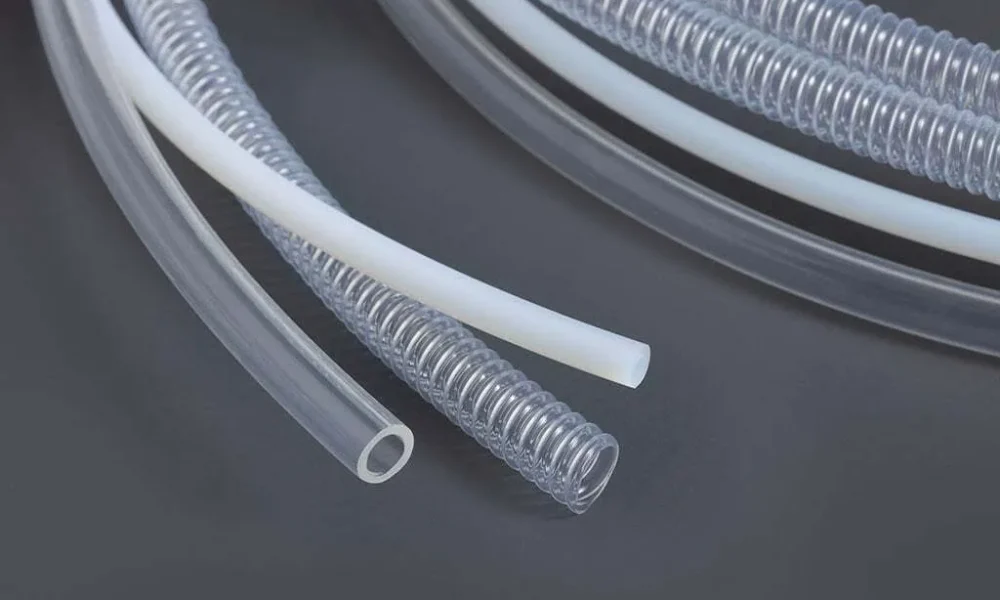

PFA (perfluoroalkoxy) is a fully fluorinated, melt-processable fluoropolymer that combines the near-universal chemical resistance of PTFE with melt-processability, a 500°F (260°C) continuous service temperature, and ultra-high purity. That combination makes it the fluoropolymer of choice for the most demanding chemical, semiconductor, and high-purity fluid-handling applications — where it delivers PTFE-level inertness in a material that can be conventionally extruded, molded, welded, and produced to ultra-low extractable levels. As a North American manufacturer of high-performance polymers, Pexco processes PFA into tubing, pipe , rod , and custom components across high-melt-flow, high-performance, and ultra-high-purity (UHP) grades, plus dual-containment construction.
This article covers what PFA is, its key properties, how it compares to PTFE, PVDF, and FEP, the grades and forms Pexco supplies, and where it fits by application.
What is PFA?
PFA (perfluoroalkoxy) is a fully fluorinated, melt-processable fluoropolymer in the same family as PTFE (polytetrafluoroethylene), FEP (fluorinated ethylene propylene), and PVDF (polyvinylidene fluoride). It shares PTFE’s near-universal chemical resistance and 500°F service ceiling, but — unlike PTFE, which must be paste-extruded and sintered — PFA melts and flows at processing temperature, so it can be conventionally extruded, injection molded, and heat-welded. PFA also offers exceptional surface smoothness and very low extractables, which is why it is the standard material for ultra-high-purity semiconductor and pharmaceutical fluid handling.
PFA is often confused with Teflon™. “Teflon” is a Chemours trademark applied to several fluoropolymers — including PTFE, FEP, and PFA — so PFA sold as Teflon™ PFA is the same perfluoroalkoxy chemistry under a brand name. PFA is not the same material as PTFE: PFA is the melt-processable member of the family, while PTFE is the non-melt-processable one. For the full distinction, see the PFA vs. PTFE comparison below.
PFA Properties
PFA pairs the chemical inertness of a fully fluorinated polymer with melt-processability and purity. Its defining properties:
- Continuous service temperature up to 500°F (260°C) — equal to PTFE and the highest in the melt-processable fluoropolymer group.
- Near-universal chemical resistance — inert to nearly all acids, bases, oxidizers, and solvents.
- Melt-processability — conventionally extruded, injection molded, and welded, unlike PTFE.
- Ultra-high purity — UHP PFA grades reach extractable levels below 1 PPB with minimal particle generation.
- Superior dielectric properties and dimensional stability at elevated temperature.
- Exceptional surface smoothness and low moisture absorption, which resist particle entrapment and contamination.
The property-by-property comparison against the other fluoropolymers is in the table below.
What Is the Maximum Service Temperature of PFA?
PFA has a continuous service temperature of up to 500°F (260°C) — the same ceiling as PTFE, and higher than FEP (400°F) or PVDF. It holds its mechanical strength, dimensional stability, and dielectric properties at elevated temperature with minimal outgassing, which is why it is specified for high-temperature chemical and electrical service where melt-processable FEP would be under-rated.
How Does PFA’s Chemical Resistance Compare?
PFA is fully fluorinated, so it offers near-universal chemical resistance — inert to nearly all acids, bases, oxidizers, and solvents — on par with PTFE and a step above the partially fluorinated PVDF, which has limited compatibility with some solvents. Against FEP, PFA carries the same broad resistance but to a higher temperature (500°F vs. 400°F). For a specific chemical, confirm compatibility and service temperature; where the application needs the same inertness at lower cost and below 400°F, FEP is the value alternative, and where it needs the highest purity, UHP PFA is the choice.
PFA vs. PTFE, PVDF, and FEP
Selecting the right fluoropolymer means matching chemical resistance, temperature, processability, and purity to the application. PFA’s advantage is that it holds PTFE-level chemical resistance and temperature and is melt-processable, smoother, and weldable — at a higher cost than the other grades. The table compares the four fluoropolymers Pexco processes.
| Property | PFA | PTFE | PVDF | FEP |
|---|---|---|---|---|
| Chemical resistance | Excellent resistance to nearly all chemicals | Excellent resistance to most chemicals | Good, but limited with certain solvents | Very good, but less than PFA |
| Maximum continuous use temperature | 260°C (500°F) | 260°C (500°F) | 121°C (250°F) | 204°C (400°F) |
| Melt processability | Yes | No (must be sintered) | Yes | Yes |
| Permeation resistance | Good to superior* (*specific grades) | Good | Good | Good |
| Clarity | Transparent to translucent | Translucent to opaque | Opaque | Transparent to translucent |
| Surface smoothness | Exceptional | Very good | Good | Very good |
| Weldability | Good | Poor | Good | Good |
For a full material-by-material breakdown, see the PFA vs. PTFE comparison guide.
PFA Grades and Forms
Pexco supplies three PFA resin grades — each engineered for a different balance of processability, performance, and purity — plus a dual-containment construction.
High-melt-flow PFA. Higher-melt-flow virgin resins used in injection molding, where greater flow fills intricate cavities.
High-performance PFA. Low-melt-flow resin used for tubing, pipe, rod, and other extrusions — excellent chemical resistance, thermal stability, and mechanical properties for most critical applications, at an optimal balance of performance and value for general chemical processing and less demanding high-purity work.
Ultra-high-purity (UHP) PFA. Engineered for semiconductor, pharmaceutical, and other contamination-sensitive industries: exceptionally low extractable levels (below 1 PPB), minimal particle generation, enhanced surface smoothness, extreme stress-crack resistance, superior flex life, cleanroom processing, and full traceability and lot control. Pexco supplies it as Altaflo 480 UHP PFA tubing and pipe. See also UHP PFA for semiconductor manufacturing.
Dual-containment PFA. A tube-in-tube design with an inner PFA carrier and outer PFA containment layer, custom-engineered for the safe transport of highly toxic, corrosive, or high-value chemicals. See dual-containment PFA systems.
Pexco supplies these as PFA and UHP PFA tubing and pipe, rod, and machined or molded components in a range of sizes, with custom extrusion (multi-lumen, custom-profile, precision-tolerance, and co-extrusion) available.
PFA Applications
PFA is specified where chemical resistance, temperature, and purity all have to hold at once. Its core applications:
- Semiconductor manufacturing — UHP PFA tubing with <1 PPB extractables, custom fluid-handling components for aggressive etchants and cleaning chemistries, and cleanroom gas-distribution components, where sub-PPB contamination compromises yields. See semiconductor.
- Chemical processing — PFA tubing, pipe, and machined or molded components for chemical-transport lines carrying concentrated acids and oxidizers, and high-purity manifold systems for critical process chemicals, drawing on PFA’s resistance to acids, bases, and solvents. See fluid handling.
- Pharmaceutical production — USP Class VI compliant PFA tubing and high-purity process lines for API production, drawing on PFA’s ultra-low extractables and cleanability. See medical & life sciences.
- Food and beverage processing — FDA-compliant PFA tubing and components for food-contact service, drawing on PFA’s non-stick surface and chemical resistance.
- Laboratory and analytical — high-purity PFA tubing and machined sample-handling components for trace analysis and analytical instruments, where the material must not contaminate the sample.
- Aerospace & defense, oil & gas, electronics, and environmental monitoring — high-temperature wire insulation, downhole chemical-injection and high-pressure sampling lines, ultra-pure fluid delivery for PCB and etch processes, and chemical-resistant sampling components. See electrical & electronics and aerospace & defense.
PFA Machining, Fabrication, and Custom Manufacturing
Pexco’s value in PFA is processing: as a North American fluoropolymer manufacturer, the company converts virgin PFA resin into finished tubing, pipe, rod, and machined or molded components to engineered tolerances. Capabilities span CNC and multi-axis machining of complex PFA parts, precision extrusion of tubing, pipe, rod, and profiles, injection molding of components, and secondary operations (drilling, threading, surface finishing), backed by dimensional verification, pressure testing, material certification, and lot control. Because the extrusion and converting run in-house, a PFA requirement can be matched to the right grade, wall, and dimension — from prototype through full production — including multi-lumen tubing, custom profiles, precision-tolerance tubing, and co-extrusions.
PFA Specifications and Certifications
Applicable Pexco PFA grades are available with the specifications and documentation below, depending on grade and application:
- ASTM D3307 — PFA resin
- SEMI F57 and C90 — semiconductor ultra-high-purity standards
- NSF 61 and NSF 372 — drinking-water system components
- USP Class VI — compliant resins for pharmaceutical/API production
- FDA 21 CFR 177.1550 — food-contact compliance (perfluorocarbon resin)
Frequently Asked Questions
What is PFA material?
PFA (perfluoroalkoxy) is a fully fluorinated, melt-processable fluoropolymer that combines the near-universal chemical resistance of PTFE with melt-processability, a 500°F (260°C) service temperature, exceptional surface smoothness, and ultra-high purity. Unlike PTFE, it can be conventionally extruded, injection molded, and welded. PFA is used for chemical-processing and semiconductor fluid handling, pharmaceutical and laboratory systems, and high-temperature electrical insulation.
Is PFA the same as Teflon?
Not exactly. “Teflon” is a Chemours trademark applied to several fluoropolymers — including PTFE, FEP, and PFA — so PFA sold as Teflon™ PFA is the same perfluoroalkoxy material under a brand name. But PFA is not the same as PTFE: in everyday use “Teflon” most often means PTFE, and PFA is the distinct, melt-processable member of the same fluoropolymer family. PFA matches PTFE’s chemical resistance and 500°F service temperature while adding melt-processability, surface smoothness, and ultra-high purity.
What is the maximum service temperature of PFA?
PFA has a continuous service temperature of up to 500°F (260°C), equal to PTFE and higher than FEP (400°F) or PVDF. It maintains mechanical strength, dimensional stability, and dielectric properties at elevated temperature with minimal outgassing.
What is the difference between PFA and PTFE?
PFA and PTFE share near-universal chemical resistance and the same 500°F service ceiling, but PFA is melt-processable, smoother, weldable, and clearer, while PTFE must be paste-extruded and sintered. Choose PFA when an application needs PTFE-level resistance plus melt-processability, surface smoothness, or ultra-high purity; choose PTFE for the lowest friction and filled or machined stock.
What is the difference between PFA and FEP?
PFA and FEP are both melt-processable, transparent, fully fluorinated fluoropolymers with near-identical chemical resistance. The difference is temperature, purity, and cost: PFA is rated to 500°F and reaches the lowest extractable levels for semiconductor service, while FEP is rated to 400°F and costs less. PFA is specified when service runs hotter or demands ultra-high purity; FEP is the value choice below 400°F.
Is PFA suitable for semiconductor and ultra-high-purity applications?
Yes. Ultra-high-purity (UHP) PFA is the standard material for semiconductor wet-process and chemical-delivery systems, with extractable levels below 1 PPB, minimal particle generation, enhanced surface smoothness, and cleanroom processing with full traceability. Pexco’s UHP PFA supports semiconductor requirements with SEMI F57/C90 documentation where applicable.
Is PFA FDA compliant for food contact?
Yes. Pexco’s PFA is FDA compliant for food-contact applications under 21 CFR 177.1550, and its UHP grades use USP Class VI compliant resins for pharmaceutical production. Pexco’s PFA also meets ASTM D3307 (PFA resin) and NSF 61 and NSF 372 for drinking-water system components. Confirm the applicable certifications and documentation for your grade and application when you request a quote.