Our Products
Our Brands
Markets
Capabilities
About Pexco
PTFE (Teflon™): Properties, Grades & Applications
PTFE (polytetrafluoroethylene) is a fully fluorinated fluoropolymer with the broadest service-temperature range and the lowest coefficient of friction of any fluoropolymer, and it resists nearly all industrial chemicals and solvents. Teflon™ is the Chemours brand name for PTFE — the two describe the same material. Pexco manufactures PTFE in North America under its Altaflo® and Enflon® brands, converting it into sheet, rod, tubing, film, cylinders, and tape in virgin and filled grades, as machining stock and finished components for chemical, semiconductor, electrical, medical, and aerospace applications. Continuous service to 500°F (260°C), near-universal chemical inertness, and FDA-compliant grades make PTFE the fluoropolymer most often specified when an application needs maximum chemical and temperature resistance rather than mechanical strength.
This article covers what PTFE is and how it relates to Teflon, its key properties, its chemical resistance, how it compares to other fluoropolymers, the grades and forms Pexco supplies, and where it fits by application.
Table of Contents
What is PTFE — and is it the same as Teflon?
PTFE (polytetrafluoroethylene) is a semi-crystalline, fully fluorinated fluoropolymer, and Teflon™ is simply a brand name for it. PTFE was first developed by DuPont (now Chemours), which sells it under the Teflon™ trademark; “PTFE” is the generic material name and “Teflon” is one manufacturer’s brand, so a Teflon sheet and a PTFE sheet are the same material. Other producers sell the same polymer under their own names.
PTFE sits in the fluoropolymer family alongside FEP (fluorinated ethylene propylene), PFA (perfluoroalkoxy), and PVDF (polyvinylidene fluoride). Because every bond along its carbon backbone is shielded by fluorine, PTFE is almost completely inert and carries the highest continuous-use temperature in routine fluoropolymer service. That full fluorination is also why PTFE is not melt-processable like FEP and PFA: it is shaped by compression molding, paste (ram) extrusion, and skiving, then machined to finished tolerances. The trade-off for its chemical and thermal performance is mechanical — PTFE has lower tensile strength and higher creep than PVDF or the reinforced grades, which is why load-bearing PTFE parts are often specified in a filled grade.
PTFE Properties
PTFE’s properties make it the chemical- and temperature-resistance benchmark of the fluoropolymer family: chemically inert, rated for continuous service to 500°F, UL 94 V-0, and the lowest-friction solid commonly specified. The table below lists the measured physical properties of Pexco’s Altaflo® 100 PTFE, produced from 100% virgin-grade PTFE resin.
| Physical Property | ASTM Test | Value (Altaflo 100 PTFE) |
|---|---|---|
| Upper service temperature | — | 500°F (260°C) continuous; 550°F short-term |
| Service temperature range | — | -410°F to 500°F |
| Melting point | — | ~621°F (327°C) ⚑ VERIFY WITH SME: standard PTFE value, not on the Altaflo sheet |
| Specific gravity | D 792 | 2.15 |
| Tensile strength | D 1708 | 2,500–3,000 psi |
| Elongation | D 638 | 200–400% |
| Flexural modulus | D 790 | 27,000 psi |
| MIT flex life | D 2176 | 1,000,000+ cycles |
| Hardness | D 2240 | Shore D 60 |
| Coefficient of friction | — | lowest of any fluoropolymer; ~0.05–0.10 ⚑ VERIFY WITH SME: qualitative on the sheet; numeric value is a standard reference |
| Flammability | UL 94 | V-0 (resin); resists combustion, does not promote flame spread |
| Food contact | — | FDA 21 CFR 177.1550 |
| General | ASTM D 3295 | meets or exceeds |
Values are based on tests performed at 73°F and can vary with temperature, chemical concentration, and pressure. Properties shown are for Altaflo 100 (virgin PTFE); filled grades change mechanical and wear properties (see Grades and Forms).
Two properties drive most PTFE specifications. First, the −410°F to 500°F range is the widest of any fluoropolymer, covering cryogenic service through high-temperature chemical lines. Second, PTFE’s coefficient of friction is the lowest of any solid Pexco processes, with the lubricity that makes it a standard choice for bushings, bearings, and slide surfaces.
PTFE Chemical Resistance
PTFE is chemically inert and resistant to nearly all industrial chemicals and solvents — acids, bases, oxidizers, fuels, and aggressive solvents across the full pH and temperature range — with only a few exceptions. Unlike PVDF, which has limited compatibility with strong bases and some polar solvents, fully fluorinated PTFE is attacked only by molten alkali metals and by elemental fluorine and a few related fluorinating agents at elevated temperature and pressure.
PTFE also has low permeability and does not absorb water, so it holds its properties in wet and corrosive service. This near-universal inertness is why PTFE is the benchmark against which other fluoropolymers are measured for chemical service, and why it is specified for the most aggressive chemistries where strength is secondary. For a specific chemical, check a chemical compatibility chart rather than assuming inertness, and where a line also needs mechanical strength below 250°F, compare against PVDF.
How Does PTFE Compare to Other Fluoropolymers?
PTFE offers the highest chemical resistance, the widest temperature range, and the lowest friction of the common fluoropolymers, but the lowest tensile strength — and it is the only one of the four that is not melt-processable. FEP and PFA share most of PTFE’s chemical inertness while being melt-processable (so they can be conventionally extruded and molded), and PFA matches its 500°F service. PVDF gives up the top end of the chemical and temperature range in exchange for far higher mechanical strength. The table compares upper service temperature and tensile strength across Pexco’s Altaflo fluoropolymer grades.
| Material | Grade | Upper Service Temp | Tensile Strength |
|---|---|---|---|
| PTFE (polytetrafluoroethylene) | Altaflo 100 | 500°F (550°F short-term) | 2,500–3,000 psi |
| FEP (fluorinated ethylene propylene) | Altaflo 200 | 400°F | 4,000 psi |
| PFA (perfluoroalkoxy) | Altaflo 400 | 500°F | 4,500 psi |
| PVDF (polyvinylidene fluoride) | Altaflo 500 | 250°F | 5,000–7,000 psi |
| ETFE (ethylene tetrafluoroethylene) | Altaflo 700 | 300°F | 3,100–6,800 psi |
In short: choose PTFE for the broadest chemical resistance, the highest temperatures, the lowest friction, and cryogenic capability; choose FEP or PFA when the part has to be melt-extruded or molded to a complex geometry; and choose PVDF when the line needs mechanical strength and abrasion resistance at moderate temperature. For a direct material-by-material breakdown, see the PFA vs. PTFE comparison guide and the PVDF vs. PTFE comparison guide.
PTFE Grades and Forms
Pexco supplies PTFE as sheet, rod, tubing, film, cylinders, and tape — in virgin and filled grades — so the same chemistry can be matched to machining stock, a finished component, or a chemical-service line. Pexco converts the resin rather than producing it, which means the form, grade, and dimension can be matched to the application instead of forced onto a stock size.
PTFE sheet and film (also sold as Teflon sheet). Pexco’s PTFE sheet and film includes molded sheets, skived rolls and sheets, skived tape, and pressure-sensitive (self-adhesive) tape, available etched one or two sides for bonding. These serve gaskets, slide plates, electrical insulation, and release surfaces.
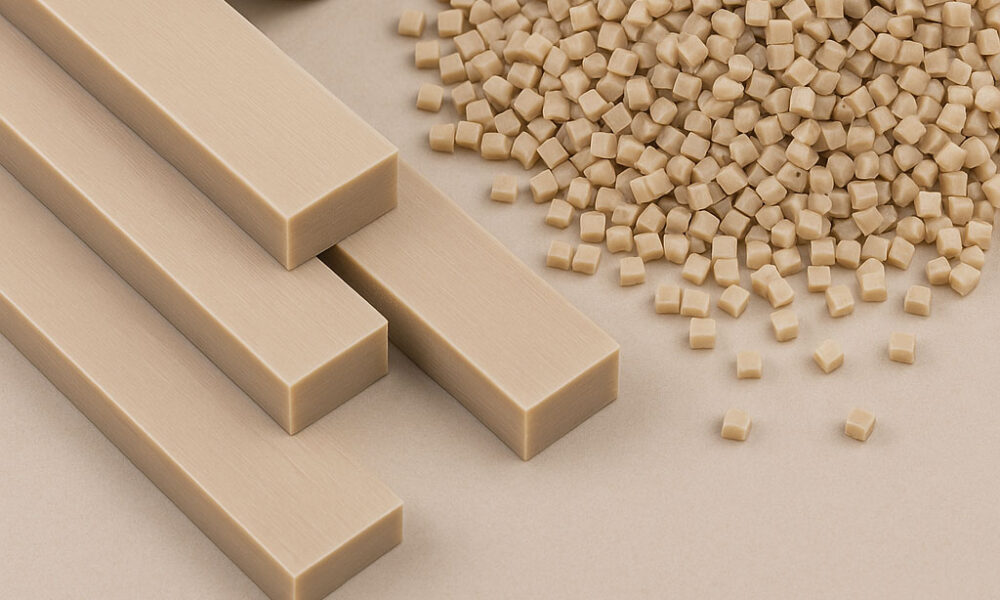
PTFE rod and machining stock. Pexco’s PTFE rod is available as molded and extruded rod and molded cylinders, supplied as machining stock for bushings, bearings, seals, and turned or milled components.
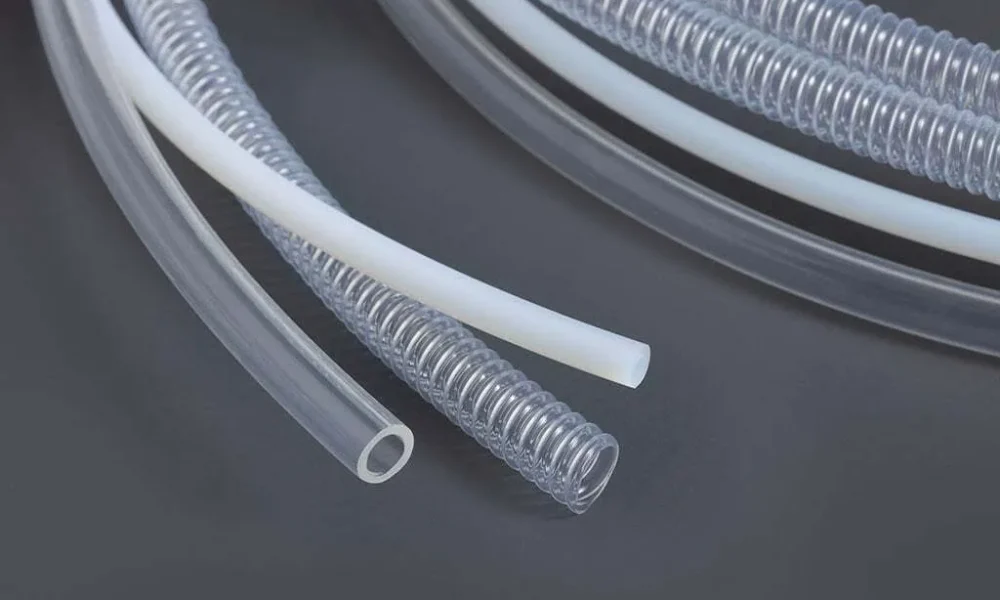
PTFE tubing. Pexco extrudes PTFE into flexible tubing — including Altaflo 100 PTFE tubing , the most flexible fluoropolymer tubing in the Altaflo line, with the broadest temperature range and chemical resistance for laboratory, analytical, and chemical-process service.
Virgin and filled grades. Virgin PTFE delivers the baseline properties in the table above. Filled PTFE grades blend the resin with glass, carbon, graphite, bronze, or stainless steel to raise wear resistance, load capacity, and dimensional stability for bearings, seals, and high-pressure components — at some cost to chemical resistance and dielectric performance. Pexco offers Standard, Premium, High-Performance, Modified, and Reprocessed resin grades, with custom resins and blends available.
The Enflon® PTFE line is ISO 9001:2015 certified and ROHS, REACH, and conflict-mineral compliant. For food-contact use, PTFE is FDA compliant under 21 CFR 177.1550.
PTFE Tubing for Chemical, Laboratory, and Medical Service
PTFE tubing is the fluoropolymer tubing of choice when a line has to carry aggressive chemistry, hold purity, or run at temperature extremes — and Pexco extrudes it in the United States to custom dimensions and cut lengths, not just stock coils. Altaflo® 100 PTFE tubing is the most flexible fluoropolymer tubing Pexco makes, with the broadest temperature range (−410°F to 500°F) and the chemical inertness to resist nearly all industrial chemicals and solvents. Its smooth, low-friction bore resists buildup and adhesion, which is why it is specified for analytical and laboratory fluid lines, chemical transfer, and medical fluid paths.
For tubing, three questions usually decide the spec:
- Chemical resistance — PTFE tubing resists nearly all acids, bases, oxidizers, and solvents with low permeability, making it the default for corrosive and high-purity fluid transfer. Where a line also needs mechanical strength below 250°F, compare PVDF.
- Temperature and pressure — continuous service to 500°F, with published working-pressure and bend-radius data by wall and diameter, in industrial, custom, heavy-wall, and metric sizes.
- Medical and FDA compliance — PTFE is FDA compliant for food contact under 21 CFR 177.1550, and Pexco supplies medical-grade tubing with USP Class VI and ISO 10993 biocompatibility testing available.
Because Pexco extrudes and fabricates in-house as a North American manufacturer, PTFE tubing can be supplied to a custom inner diameter, outer diameter, and wall, cut to length, and produced in production volumes. That lets Pexco match the grade, dimension, and cut length to the chemical-service, laboratory, semiconductor, or medical requirement rather than starting from a fixed catalog size.
PTFE Applications
PTFE is specified where chemical inertness, temperature resistance, low friction, or dielectric performance matters more than mechanical strength. Its core applications cluster in several areas, detailed in the PTFE applications across industries overview:
- Chemical processing and fluid handling — chemical-transfer tubing, gaskets, seals, and linings that see aggressive acids, oxidizers, and solvents at temperature. See fluid handling.
- Semiconductor — fluid-handling and chemical-delivery components where PTFE’s purity and inertness protect process chemistry. See semiconductor.
- Electrical and electronics — wire insulation, standoffs, and high-frequency dielectric components, where PTFE’s low dielectric constant and high temperature rating are the deciding properties. See electrical & electronics.
- Medical and life sciences — fluid paths, low-friction surfaces, and machined components in PTFE’s FDA-compliant grades. See medical & life sciences.
- Aerospace and defense — bearings, seals, insulation, and low-friction components for high- and low-temperature extremes. See aerospace & defense.
- Low-friction mechanical components — bushings, bearings, slide plates, and wear surfaces across industries, where filled PTFE grades add the load capacity that virgin PTFE lacks.
How Pexco Processes PTFE
Because PTFE is not melt-processable, Pexco shapes it by compression molding, paste extrusion, and skiving, then finishes parts by precision machining — CNC milling, CNC turning, and Swiss machining. Running molding, extrusion, and machining in-house lets a PTFE requirement be matched to the right grade (virgin or filled), form (sheet, rod, tube, cylinder), and dimension, then machined to tolerance, rather than sourced as a stock shape and reworked. Additional services include annealing (stress relief), one- and two-sided etching for bonding, centerless grinding, and cut-to-size fabrication. This processing-and-converting capability, applied across the full fluoropolymer line, is what lets Pexco route a single chemical, electrical, or mechanical requirement to the correct PTFE form. Custom sizes are available on request.
Frequently Asked Questions
What is PTFE material?
PTFE (polytetrafluoroethylene) is a fully fluorinated, semi-crystalline fluoropolymer known for near-universal chemical resistance, continuous service to 500°F (260°C), and the lowest coefficient of friction of any fluoropolymer. It is widely sold under the brand name Teflon™. PTFE is used as sheet, rod, tubing, and machined components for chemical processing, semiconductor, electrical, medical, and aerospace applications.
Is PTFE the same as Teflon?
Yes. PTFE (polytetrafluoroethylene) is the generic material name, and Teflon™ is the Chemours brand name for the same polymer, first developed by DuPont. A “Teflon sheet” and a “PTFE sheet” are the same material; other manufacturers sell the same polymer under their own brand names. Pexco manufactures PTFE in North America under its Altaflo® (tubing) and Enflon® (rod, sheet, and machining stock) brands.
What is the temperature range of PTFE?
PTFE has a service temperature range of approximately -410°F to 500°F (260°C) continuous, with short-term capability to 550°F — the broadest range of any fluoropolymer, from cryogenic service to high-temperature chemical lines. Its melting point is higher still, around 621°F (327°C), but continuous service is capped well below that because mechanical strength falls off as temperature rises.
What is the melting point of PTFE?
PTFE has a melting point of approximately 621°F (327°C). Melting point is not the same as service temperature: PTFE’s continuous upper service temperature is 500°F (260°C), below its melt point, because the material softens and loses mechanical strength before it melts.
What chemicals is PTFE resistant to?
PTFE is resistant to nearly all industrial chemicals and solvents — acids, bases, oxidizers, fuels, and aggressive solvents — across the full pH range and at temperature. The few exceptions are molten alkali metals and elemental fluorine and related fluorinating agents at elevated temperature and pressure. For a specific chemical, check a chemical compatibility chart rather than assuming inertness.
What is the difference between PTFE and PVDF?
PTFE resists nearly all chemicals and handles a wider temperature range (up to 500°F, plus cryogenic service), while PVDF offers far higher tensile strength, better abrasion resistance, and lower cost at moderate temperatures below 250°F. Choose PTFE for the most aggressive chemistries, the highest and lowest temperatures, and the lowest friction; choose PVDF for pressurized, abrasive, or structural chemical-service lines. See the PVDF vs. PTFE comparison guide for a full breakdown.
Is PTFE tubing FDA approved or medical grade?
PTFE is FDA compliant for food-contact applications under 21 CFR 177.1550, and Pexco supplies medical-grade PTFE tubing for fluid paths and device applications, with USP Class VI and ISO 10993 biocompatibility testing available. PTFE’s smooth, low-friction, chemically inert bore makes it well suited to medical and laboratory fluid handling. Confirm the specific certifications your application requires when you request a quote.
Can I get custom or bulk PTFE tubing?
Yes. Pexco extrudes PTFE tubing in the United States to custom inner diameter, outer diameter, and wall thickness, cut to length, and in production volumes. Standard Altaflo 100 sizes span industrial, heavy-wall, and metric dimensions, and custom tubing is available on request for chemical, laboratory, semiconductor, and medical applications.